
INTRODUCTION:
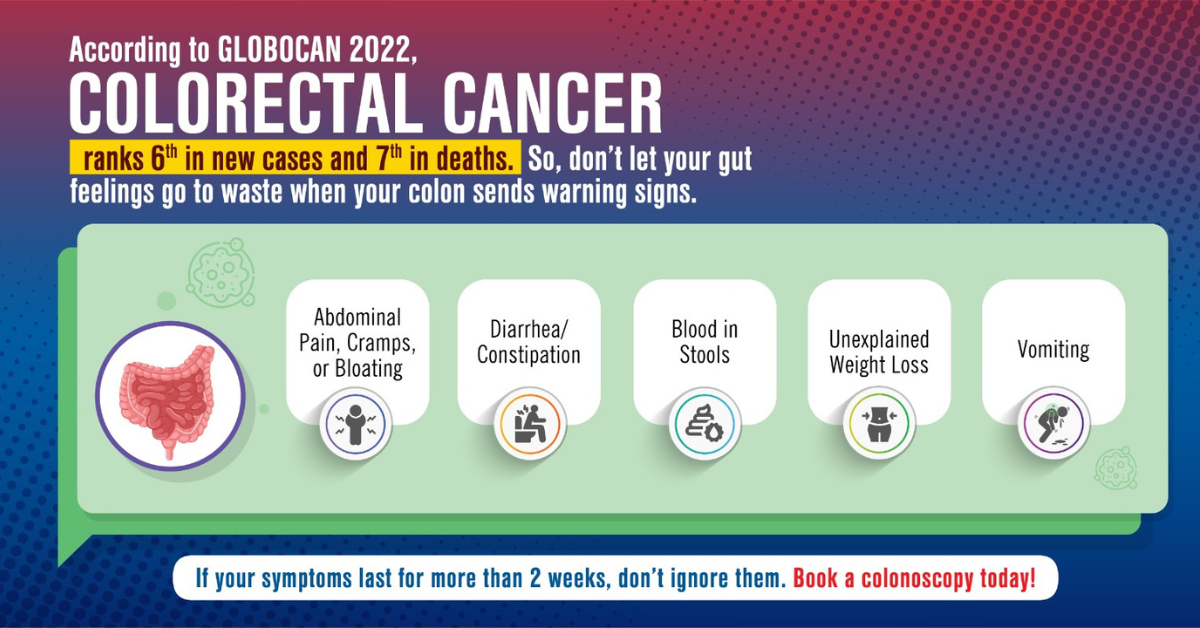
As per GLOBOCAN 2022 data, Colorectal cancer (CRC) ranks 6th in new cases and 7th in number of deaths annually. Environmental and genetic factors can increase the likelihood of developing CRC. Obesity, diabetes, tobacco use, excess consumption of alcohol, excess consumption of processed meat, and lack of physical activity are risk factors for CRC. With increasing obesity rates, diet high in processed food and changing lifestyle, the incidence of CRC is increasing, especially early onset CRC (age <50 years). At SGHOC, one of the best colon cancer hospitals in India, especially in South Gujarat – most patients of CRC present to us in 3 ways:
- No symptoms but diagnosed during routine screening for CRC or incidentally detected by a test done for other reasons
- Suspicious symptoms and/or signs
- Emergency room admission due to gastrointestinal bleed, obstruction or perforation
CRC is insidious in nature as it silently progresses in early stages. When the symptoms arise, CRC is usually in its advanced stages. The 5 – year survival rates for early-stage localized CRC and advanced stage CRC are approximately 90% and 20%, respectively. Early detection via screening protocols can improve outcomes, especially in India, where incidence and mortality rates of CRC are higher due to lack of social or community awareness, inadequate screening programs, late – stage presentation, delay in diagnosis due to socio – economic factors and inaccessibility or poor adherence to evidence based standard treatment guidelines. CRC usually starts as polyps. These polyps are small non – cancerous lesions on the inner lining of colon and/or rectum. If left undetected they grow over time and become malignant. Colonoscopies done as screening test around age of 45 years, can detect polyps before they become cancerous, preventing around 60% of deaths. Early signs of CRC are vague, mimic everyday digestive issues and when persistent for more than a few weeks should be thoroughly investigated.
ASYMPTOMATIC INDIVIDUALS:
Most patients of early-stage CRC are asymptomatic, are mostly diagnosed during colonoscopy screening or during imaging done for other reasons (incidental). The United States Preventive Services Task Force (USPSTF) recommends initiating screening at age 45 years in most average-risk adults and to continue till age of 75 years. At SGHOC, one of the best colon cancer hospitals in India, especially in South Gujarat, Dr. Dhruv Mehta recommends screening tests according to USPSTF recommendations not just in colon cancer, but in breast, prostate, cervical and ovarian cancers too. At the first clinic visit itself, we assess the patient’s risk of CRC and advise appropriate screening tests like colonoscopy or fecal immunochemical testing (FIT). For patients who prefer colonoscopy, we perform it every 10 years. For patients who prefer noninvasive testing or in areas where access to colonoscopy is limited, we typically offer screening by FOBT (Fecal occult blood test) annually on a single stool sample. For patients with family history of cancer syndromes like Lynch or FAP (Familial Adenomatous Polyposis), or first degree relative (FDR) with documented serrated polyps or adenoma > 1 cm size with high – grade dysplasia or tubulovillous histology, we begin screening at age 40 years or 10 years before the FDR’s diagnosis, whichever is earlier. We typically screen with a colonoscopy every five years. Sometimes, CRC is incidentally detected during radiological tests done for other reasons – like during CT scan done for evaluation of renal stones
SYMPTOMATIC INDIVIDUALS:
One of the most common symptoms of CRC is changes in bowel habits seen in approximately 75% of the patients. This can manifest as persistent diarrhea, constipation, or alternating between the two. This shifts in bowel habits occur due to obstruction or irritation of bowel lumen by a growing tumor, altering the consistency of passing stools. For example, if a tumor in left colon or rectum narrows the bowel lumen, it can lead to pencil – thin stools. In early stages, symptoms might be intermittent, but as the cancer progresses, they become more consistent. Millennials or Gen Z commonly attribute alternating diarrhea and constipation habits to stress and irregular unhealthy diet habits and is often misdiagnosed as IBS (irritable bowel syndrome) by primary care physicians.
Blood in stools is yet another common symptom of CRC and is often dismissed as due to hemorrhoids. Rectal bleeding in combination with change in bowel habits is the most common symptom combination seen in approximately 70% of the patients. Blood can appear bright red (from lower colon/rectum) or dark/maroon (higher up), or make stool black and tarry (melena) if digested. This occurs when tumors erode blood vessels or cause ulcers. At SGHOC, any persistent rectal bleeding after age of 40 years is screened for CRC.
Persistent abdominal pain, cramping, or bloating due to blockages and inflammation because of tumor is common symptom in early – onset CRC (EOCRC) affecting almost 45% of the patients. Due to vague nature of symptoms, it is often misdiagnosed as indigestion and treated with antacids and antispasmodics. However, if abdominal pain worsens after eating and is associated with vomiting, further investigations are required to rule out CRC.
Unexplained weight loss without diet or exercise modifications is a classic cancer sign affecting almost 20% of CRC patients. Weight loss results from reduced appetite, malabsorption, or tumor energy consumption. Chronic fatigue, often from iron-deficiency anemia due to chronic bleeding and poor diet, is subtle but significant symptom of CRC and which is often blamed to menstrual periods in females and often overlooked in males. Tenesmus—the sensation of needing to defecate but passing little—is common in rectal cancer. Its persistence helps differentiate it with constipation
Sometimes, a person’s history helps the oncologist to localize the tumor. Hence, at SGHOC which is one of the best colon cancer hospitals in India, especially in South Gujarat – a detailed history is prioritized for every patient. The following history set helps in tumor location (written verbatim from UpToDate):
- A change in bowel habits is a more common presenting symptom for left-sided than right-sided CRCs.
- Hematochezia is more often caused by rectosigmoid than right-sided colon cancer.
- Iron deficiency anemia from unrecognized blood loss is more common with right-sided CRCs. Cecal and ascending colon tumors have a fourfold higher mean daily blood loss (approximately 9 mL/day) than tumors at other colonic sites.
- Rectal cancer can cause tenesmus, rectal pain, and diminished caliber of stools.
- Obstructive symptoms are more common with cancers that encircle the bowel, producing the so-called “apple-core” description as seen most classically on barium enema, which is rarely used
CONCLUSION:
It is vital to understand that if a person is symptomatic at diagnosis, it is an indicator of advanced disease and poor prognosis. More the number of symptoms, less is the survival for colon cancer. One study has suggested that for patients who have not undergone screening, but is diagnosed through symptoms, their stage was higher, more chances of diagnosis in stage 4, higher risk of death, recurrence and shorter survival. Hence, colonoscopic screening and recognizing early symptoms and/or signs can be lifesaving. One should not ignore indigestion or any common stomach issues if they persist for more than 2 weeks.
