
Among the women of India, ovarian cancer has become the 3rd most common cancer. Data from GLOBOCAN 2022 shows 47,000+ diagnoses within twelve months, alongside 32,000+ fatalities. Since early stages tend to develop without clear symptoms, detection commonly happens late, resulting in progression going unnoticed until the condition reaches advanced phases.
This condition earns its name ‘silent killer’ due to how quietly it progresses. Symptoms appearing at first may resemble everyday discomforts like bloating, digestive issues, hormonal shifts, or bladder issues – easily dismissed without concern. Awareness gaps, slow identification, and difficulty reaching expert oncologists lead to cancer detection at advanced stages for many people throughout India.
Care at the South Gujarat Hematology Oncology Center follows rigorous medical standards, shaped by research and real-world results. Each individual receives personalized attention led by Dr. Dhruv Mehta, a leading ovarian cancer specialist, whose research based approach is known for precision and depth in clinical practice.
Early Symptoms Of Ovarian Cancer
Ovarian cancer does not show major symptoms in its early stages, ovarian cancer specialists advise women to notice the following symptoms if they persist for several weeks.
Common early symptoms include:
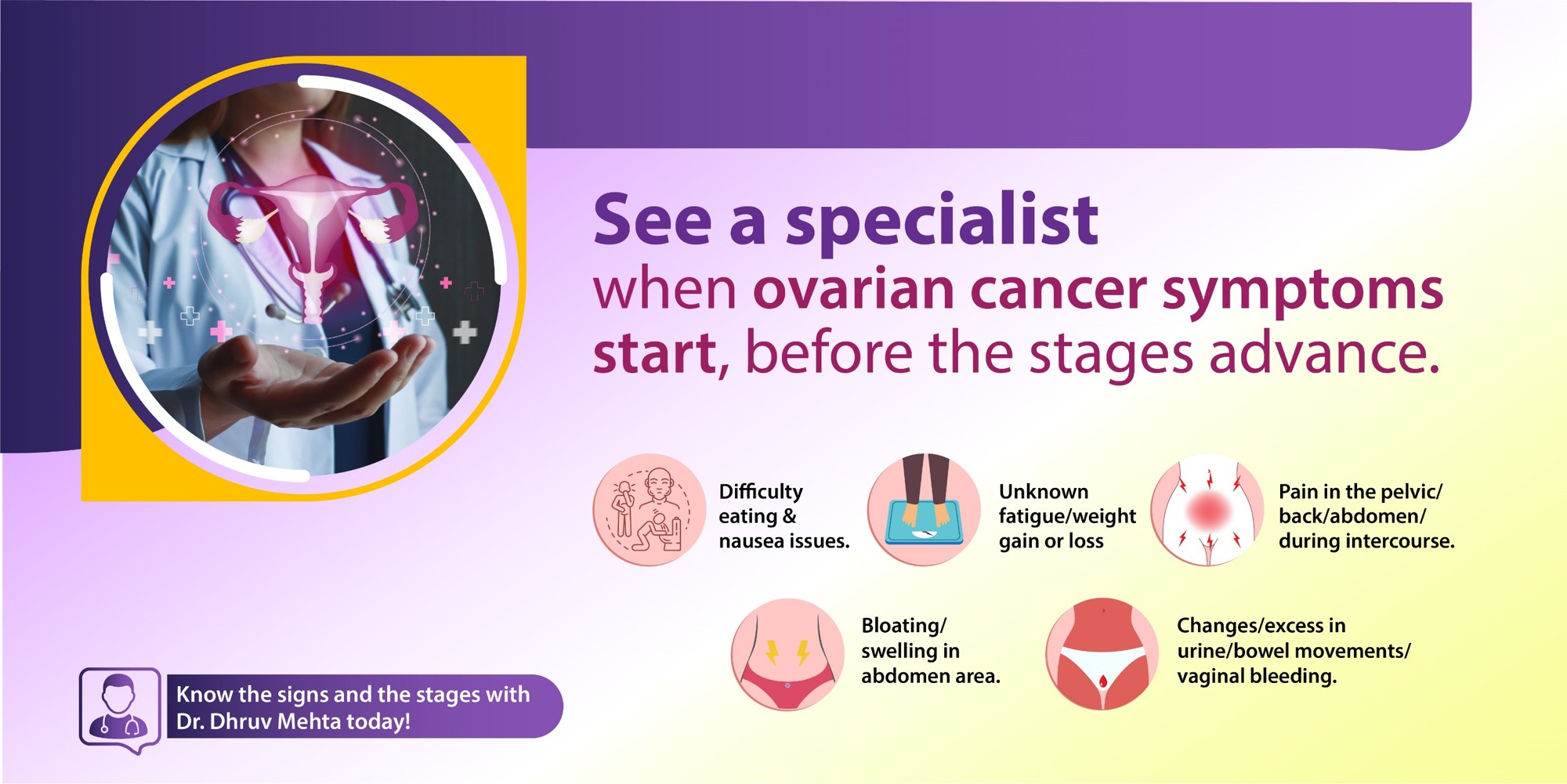
1. Difficulty eating and nausea issues
2. Unexplained fatigue/weight gain or loss
3. Pain in the pelvis/back/abdomen/during intercourse
4. Bloating/swelling in the abdominal area
5. Changes/excess in urine/bowel movements/vaginal bleeding
Who Is At A Higher Risk?
Not every woman faces the same odds of getting ovarian cancer. Having certain traits increases the likelihood – among them are:
- Age above 40 years
- Family history of cancer [ovarian/breast]
- Gene mutations [BRCA1/BRCA2]
- Never been pregnant
- Endometriosis
- Obesity
- Late menopause
Signs You Might Need A Specialist
Though small at first, certain signs can signal something serious when lasting for days or repeating often. Get a medical examination from an ovarian cancer specialist if the symptoms are:
- Are new and unusual
- Occur frequently
- Continue for more than two to three weeks
- Become more severe over time
- Occur along with bloating, pain, or appetite loss
Most individuals showing those signs get checked at SGHOC through pelvic exams, either transvaginal or transabdominal ultrasounds, blood tests, or measuring CA-125 in the bloodstream. When used together, these methods let cancer specialists spot unusual growths on the ovaries.
Stages Of Ovarian Cancer
Before the multispecialty team starts with a treatment plan, they check the spread of cancer. Early detection and understanding the spread of cancer both play an integral role in the treatment.
Stage I
Cancer is limited to one or both ovaries or fallopian tubes. At this stage, treatment outcomes are usually very good.
Stage II
Cancer has spread to nearby pelvic organs such as the uterus, fallopian tubes, or surrounding tissues but has not spread to distant organs.
Stage III
Cancer has spread outside the pelvis into the abdominal lining, lymph nodes, or nearby abdominal tissues. This is the stage at which many patients are diagnosed in India.
Stage IV
Cancer has spread to distant organs like the liver or outside the abdominal cavity. This is the final stage of cancer, considered advanced ovarian cancer.
The majority of patients reaching the South Gujarat Hematology and Oncology Center have advanced cancer at Stage III or IV. Yet improvements such as targeted therapies, milder chemotherapy plans, more precise surgeries, along with better symptom care have lifted survival chances. Even when found late, advances in treatment now stretch life spans – and improve daily living too.
Importance Of Early Detection
In the current medical space, an accurate method of routine ovarian cancer testing for asymptomatic patients does not exist. Since no reliable routine screening test exists, recognizing persistent symptoms and evaluating high-risk individuals early becomes especially important. Body changes are to be closely observed by women instead of repeatedly dismissing or self-medicating.
Conclusion
Though symptoms often start quietly, overlooking them might result in the advancement of cancer stages. Because early action matters, recognizing subtle symptoms becomes key to better outcomes. Every patient treated for ovarian cancer at South Gujarat Hematology Oncology Center gets care shaped by research and medical advancements, with Dr. Dhruv Mehta at SGHOC guiding patients through the best possible treatment from the first visit through follow-up care.
FAQs
1. Can ovarian cancer treatment affect the fertility of the patients?
Fertility might be affected after certain treatments used to treat aggressive cancer types. Surgery and chemotherapy affect patient fertility the most.
2. How long is the average ovarian cancer treatment?
How long therapy lasts changes with each individual, shaped by how far the cancer has moved and the chosen care path. Some see shorter timelines, others need more time for complete recovery.
