
Introduction:
According to GLOBOCAN 2022, lung cancer is the 3rd most common cancer in men in India and leads in the first place in cancer-related deaths. About 1,20,000 new cases of lung cancer are reported every year, while claiming about a lakh lives every year in the country. Moreover, 80-85% of patients who visit an oncologist have advanced-stage lung cancer.
In recent years, we have observed a concerning trend in our clinical practice, wherein lung cancer cases not related to tobacco exposure are increasingly reported. Now, almost 30-35% of lung cancer cases in men and 75-80% in women are non-smoking-related.
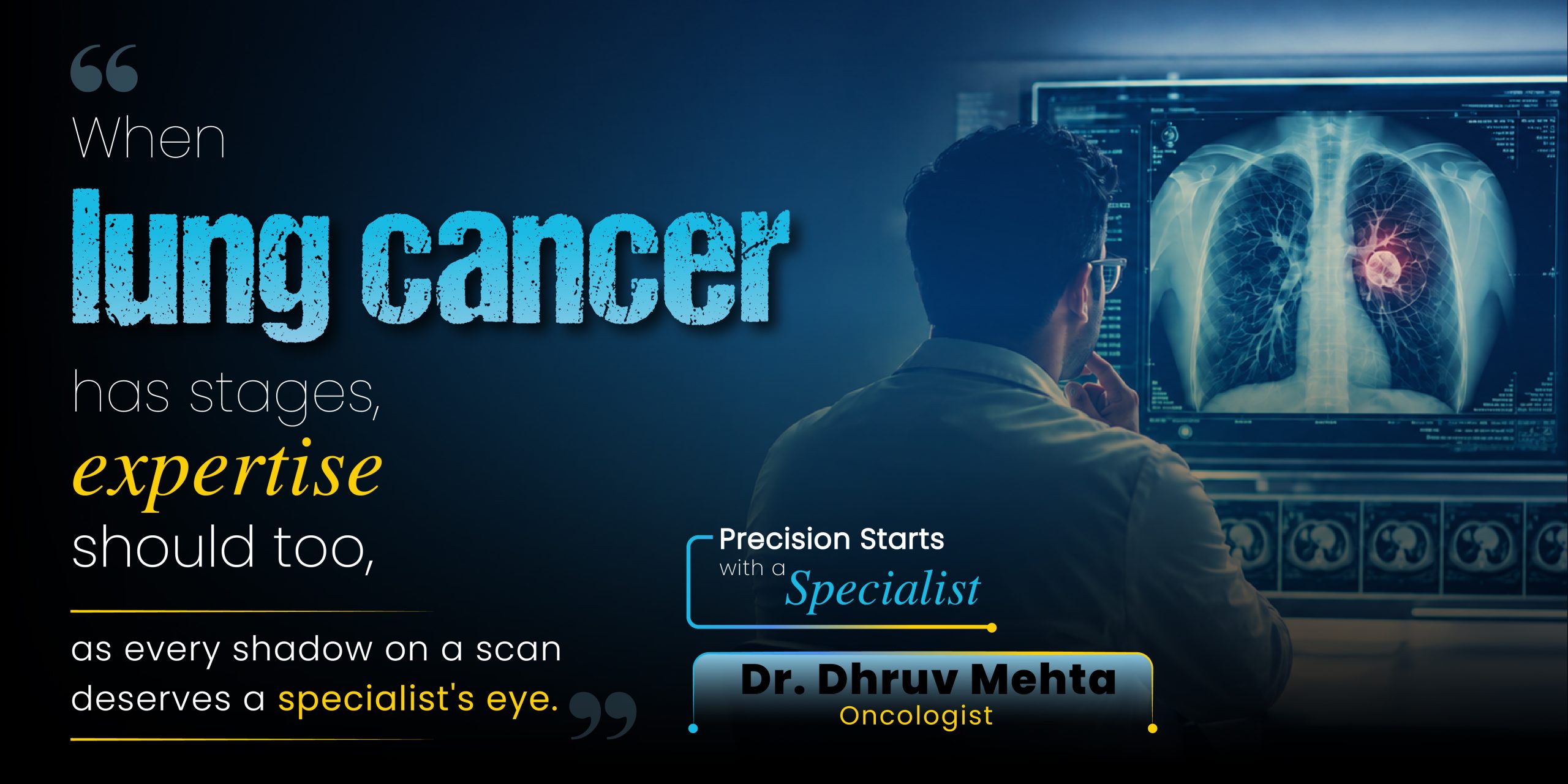
In this blog, Dr. Dhruv Mehta, a lung cancer specialist who has witnessed this changing trend over 15 years of oncological practice, will highlight the differences between a general medical oncologist and a lung cancer specialist.
General Medical Oncologist vs. Lung Cancer Specialist:
A general medical oncologist treats all cancers with basic treatment knowledge, but a cancer specialist solely focuses on all the treatment aspects of a particular cancer type. Cancer research is advancing rapidly, with almost 1 lakh new papers published every year, among which approximately 10,000 papers are dedicated to lung cancer. This lung cancer research focuses on genetics (20%), biomarkers (20%), newer systemic therapies (20%), and the rest on screening, diagnosis, and palliative care.
It is quite challenging for a general medical oncologist to remain up to date with this voluminous research while managing nearly 200 different cancer types in clinical practice. In contrast, a lung cancer specialist focuses primarily on two major categories of lung cancer, small cell lung cancer (SCLC) and non-small cell lung cancer (NSCLC).
Diagnosis And Treatment Approach:
A general medical oncologist primarily focuses on treating lung cancer, while a lung cancer specialist focuses on screening, diagnostics, prognostication, predictive biomarkers, new lung cancer clinical trials, palliative care, and lung cancer education along with general treatment.
When a patient is suspected to have lung cancer, the cancer specialist initially performs accurate clinical staging with PET-CT, Brain MRI, and Mediastinoscopy if required—to accurately determine whether the disease is potentially or entirely curable, or best managed with palliative care. A lung cancer specialist may also suggest screening of 20-pack-year smokers with LDCT between ages 50 and 74.
A biopsy may also be performed, and after that, molecular analysis is performed to determine whether targeted therapy or immunotherapy would bring the best results with minimal side effects. A general medical oncologist’s preferred treatment approach is chemotherapy, while a lung cancer specialist’s preferred treatment approach is immunotherapy and targeted therapy.
Why Choose A Lung Cancer Specialist:
While a general medical oncologist may continue with evidence-based third- and fourth-line therapies when clinically appropriate, a lung cancer specialist also evaluates eligibility for clinical trials, newer treatment approaches, and timely treatment modifications based on cancer response and molecular profile to improve the patient’s quality of life. Close monitoring of treatment response and immediate shift to second-line treatment options before the patient’s condition worsens are the primary focus of a lung cancer specialist.
Conclusion:
Management of lung cancer under dedicated lung cancer specialists like Dr. Dhruv Mehta results in the best, precise, and most favourable responses with minimal side effects without compromising QOL (Quality of Life). Staying current with the latest advances in lung cancer research enables Dr. Dhruv Mehta to focus not only on the cancer type but also on the patient’s overall health, quality of life, and long-term outcomes. For more information, consult Dr. Dhruv Mehta at SGHOC (a unit of Precision Cancer Research Institute).
